
If you're buying, selling, or just refreshing your kitchen anywhere from Kirkwood to Arnold, Hillsboro to Festus, 2026 is shaping up to be the year kitchens trade "safe and white" for "warm and personal." Buyers touring homes right now are responding to kitchens that feel current without looking like a builder-grade flip — and sellers who understand that difference are getting stronger offers. Here's what's actually trending in the St. Louis and Jefferson County markets this year, and what it costs to get there.
1. Cabinet Colors and Finishes
The stark white kitchen isn't gone, but it's no longer carrying the whole room by itself. Designers are moving toward grounded, nature-linked palettes — khaki neutrals, smoky jade green, espresso brown, and indigo blue — rather than icy grays or stark white, and cabinet manufacturers are reporting more color showing up on full runs of cabinetry, not just on a single accent island.
In local kitchens, this shows up a few consistent ways:
- Warm neutrals replacing cool whites — creamy white, greige, mushroom, and soft sand tones instead of stark white or icy gray.
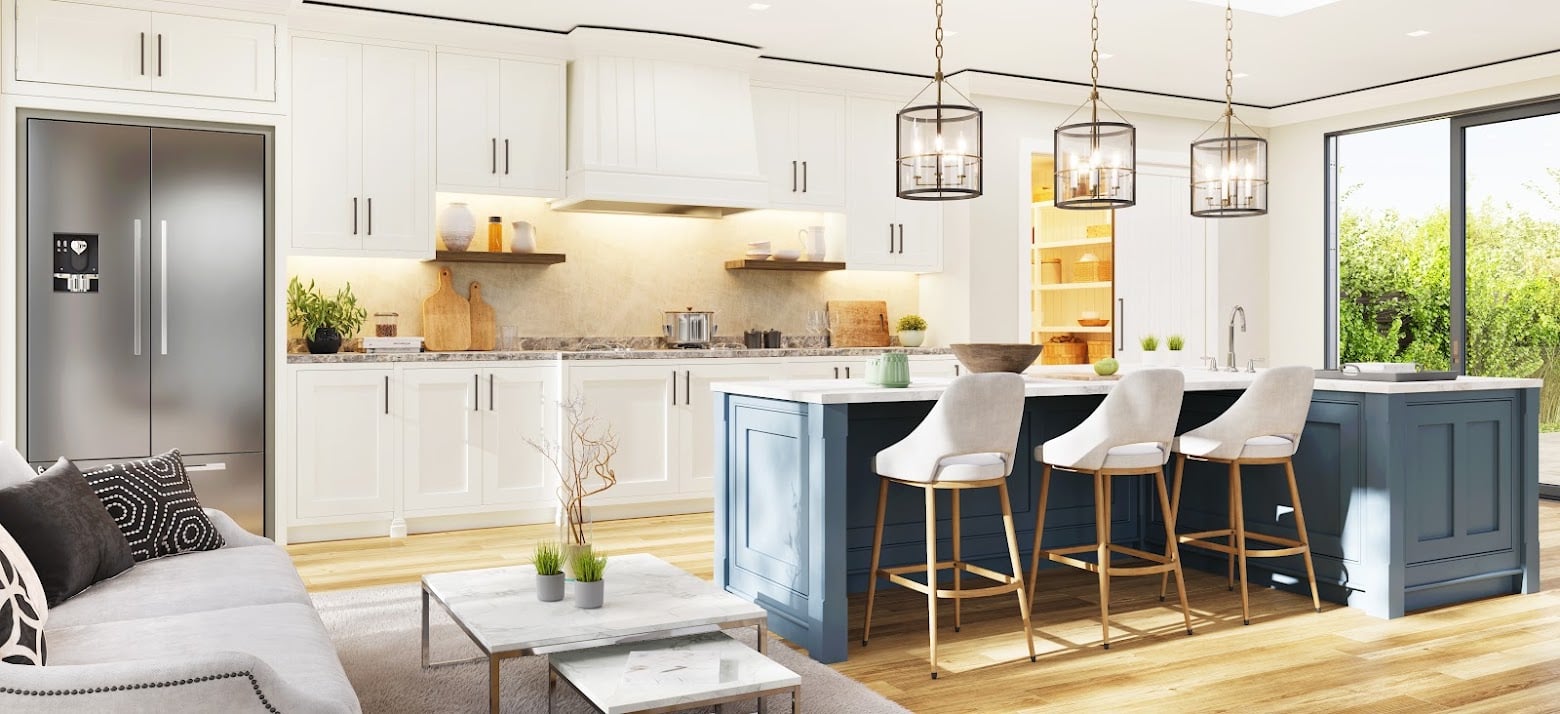
- Two-tone kitchens remain a top choice, typically a lighter perimeter paired with a deeper island or lower cabinets — a low-risk way for St. Louis homeowners to add color without committing the whole room.
- Deep, moody anchors — charcoal, matte black, and midnight blue used on an island or pantry wall rather than throughout, paired with warm greige cabinetry elsewhere.
- Natural wood species — white oak, walnut, and smoked oak are showing up more, especially on islands, with matte finishes now considered the standard rather than the upgrade.
For St. Louis sellers, this is good news: a two-tone refresh (paint the perimeter a warm white or greige, stain or paint the island a deeper accent color) is one of the most cost-effective ways to modernize a dated kitchen before listing.
2. Countertops and Backsplashes
Quartz remains the dominant countertop material in St. Louis kitchens, and it continues to lead nationally in 2026 thanks to marble-inspired veining, bold patterns, and soft neutral tones that offer a high-end look without the maintenance of natural stone. The bigger shift is in how it's being used:
- Warm, veined quartz in creams, taupe, sand, and clay tones is replacing the stark white/gray quartz that dominated the last decade.
- Full-height slab backsplashes — the same quartz slab running from the countertop straight up the wall behind the range — are a major 2026 signal, prized for the seamless, no-grout look.
- Zellige and handmade-look tile for homeowners who want texture and warmth rather than a perfectly uniform surface.
- Terracotta tile is having a real moment as a backsplash choice, pairing well with white, cream, or French-vanilla cabinetry for a cozier, less "showroom" feel.
- Large-format porcelain slabs (Dekton, Neolith, Laminam-style) are gaining traction locally for their durability, especially in busy households.
For Jefferson County homes with more rural or larger lots, we're also seeing more interest in porcelain and quartzite for outdoor kitchen tie-ins, since these hold up better to sun and weather than standard quartz.
3. Hardware and Fixtures
The "match every metal" rule is officially retired. Popular pairings in 2026 include unlacquered brass cabinet pulls with a matte black faucet, brushed nickel hardware with warm bronze lighting, and satin brass knobs with a polished chrome range hood — the idea being one dominant finish and one intentional accent, rather than three or four competing metals.
Other fixture trends we're seeing locally:
- Warm metals are back — brushed gold, champagne bronze, and unlacquered brass are the fastest-growing faucet and hardware finishes, especially paired with the warmer cabinet colors above.
- Matte black is now a supporting player, not the default — still popular, but increasingly used as an accent finish (a faucet, a light fixture) rather than applied to every touchpoint in the room.
- Oversized, low-profile pulls are replacing small knobs, giving cabinetry a cleaner, more architectural look.
- Touchless and touch-activated faucets, pull-down sprayers, and built-in filtration are common upgrade requests, particularly from move-up buyers.
4. Kitchen Layouts
The fully open floor plan that dominated the last decade is softening. Designers are increasingly building in defined zones for cooking, prep, cleanup, storage, and gathering — centered around a highly functional island — rather than one large undifferentiated workspace. In practice, for St. Louis and Jefferson County homes, that means:
- Butler's pantries and prep kitchens ("dirty kitchens") tucked just off the main kitchen, used to hide small appliances, coffee stations, and everyday clutter so the main kitchen stays photo-ready.
- Informal dining nooks built into or adjacent to the kitchen for casual meals, homework, and coffee — a more relaxed alternative to a formal dining room.
- Single, well-proportioned islands with curved or softened edges, rather than the double-island layouts seen in some higher-end builds; most local homes don't have the square footage for two islands, and buyers increasingly prefer function over showpiece scale.
This trend matters for sellers with older ranch or split-level homes common in Jefferson County: adding a small butler's-pantry-style storage wall or reconfiguring an underused nook can create the "zoned" feel buyers are looking for without a full structural remodel.
5. Storage
Storage is arguably the trend with the biggest local impact, because it's often achievable without touching the layout at all.
- Concealed storage over open shelving. Industry survey data shows a strong majority of design professionals expect walk-in and butler's pantries to stay popular over the next few years, with most homeowners preferring pantry storage concealed behind cabinet doors or panel-ready fronts rather than open shelves.
- Mixed cabinet fronts — solid, closed uppers combined with a few glass-front cabinets to add light and display space without going fully open.
- Custom pull-outs and micro-storage — deep pull-out drawers for spices, appliance garages, and storage built into previously wasted gaps (between the fridge and the wall, under counters, in toe-kicks).
- Butler's pantries built for function, not just looks — most now include a prep counter, small-appliance storage, and increasingly a beverage station or prep sink, even in modest additions.
For a lot of older St. Louis-area kitchens with limited square footage, this is the most practical upgrade path: better organization inside existing cabinetry, plus one or two targeted storage additions, rather than a full gut.
6. Local Renovation Costs
Kitchen remodel pricing in the St. Louis metro (which includes Jefferson County) runs meaningfully higher than national averages, driven mainly by labor costs rather than materials.
- Cosmetic refresh: roughly $15,000–$35,000 — keeping the existing cabinet boxes, replacing doors, hardware, and countertops, adding a new backsplash and fixtures, no layout changes.
- Mid-range full remodel: roughly $45,000–$85,000 — full cabinet replacement (semi-custom or custom), quartz or granite countertops, new flooring, updated electrical and plumbing fixtures, and new appliances.
- High-end or full gut renovation: $100,000 and up, especially once a layout change is involved — moving a wall, relocating plumbing, or shifting the island triggers permitting, structural, and re-routing costs that can roughly double a project's price.
A few local specifics worth knowing:
- St. Louis metro labor rates run about 23% above the national average, which is the single biggest reason local projects cost more than national online estimates suggest — so a national "average kitchen remodel" figure typically needs 20–25% added before it's a realistic local number.
- Cabinetry is the dominant cost driver in nearly every St. Louis kitchen remodel, typically making up 22–35% of the total project budget, and current import tariffs on cabinetry and wood products are pushing that line item up further in 2026.
- Missouri's overall construction costs run below the national average, so homeowners further out in Jefferson County sometimes see slightly softer labor pricing than homes closer to the St. Louis city core — though material and cabinetry costs stay fairly consistent across the metro.
What This Means for Buyers and Sellers
For sellers, the data points to a clear strategy: full guts rarely pay for themselves at resale, but a two-tone cabinet refresh, a warm quartz counter and full-height backsplash, updated mixed-metal hardware, and better-organized storage hit almost every trend above for a fraction of the cost of a full remodel — and they're exactly what today's buyers are responding to on a walkthrough.
For buyers, a kitchen with stark white cabinets, polished chrome hardware, and no defined storage zones isn't necessarily dated — it's simply a kitchen with room to add the 2026 touches above without a full renovation. Understanding realistic local remodel costs (see Section 6) is one of the most useful tools you can bring into a negotiation on a home that needs kitchen work.
Check out this article next